

Buy on Amazon
View on Biblioguides
It is hard to exactly classify the Redwall books by Brian Jacques. They are medieval-type fantasies, with lots of battles, duels, perilous adventures and escapes, and with a strong underlying sense of good vs. evil. But all the characters are talking animals! There is a history and a mythology behind the stories, which enriches the stories, and a wonderful sense of place in the local forest and the greater world of the books. The author also has a rollicking sense of fun, which enlivens the books with humor, sometimes gentle and sometimes outrageous. The descriptions of the food the animals eat makes the reader hungry – no chewing on plain old sticks and grass for these animals! The Redwall series is perfect for boys and girls of middle school age and up. Good upper elementary readers could probably enjoy them, too. I know I would have devoured them in 5th grade, if they had been available back in the late 1960s!
Redwall Abbey is a walled and fortified area in the middle of Mossflower Forest, with its own pond, orchards, and fields, kept mainly by the monk-type mice, with the help of enormous (to the mice) and strong badgers, joking but fierce warrior-otters, brave tree-hopping squirrels, and hares of the Long Patrol, who are jokers and ravenous eaters but unrelenting fighters. Redwall Abbey is a refuge for all peaceful and good forest animals. The Abbey is also a target, because of its riches in people and objects and its fortified position, of evil animals such as rats, weasels, stoats, foxes, snakes, toads, and cats. Although there is one line of wildcats that are good, and one rat that repents of its evil ways. He is the only “bad” character that fully repents. As far as I remember, there are no dogs in the books. Any bird characters are mixed, with some good and some bad, but mainly they don’t interact much with the ground animals.
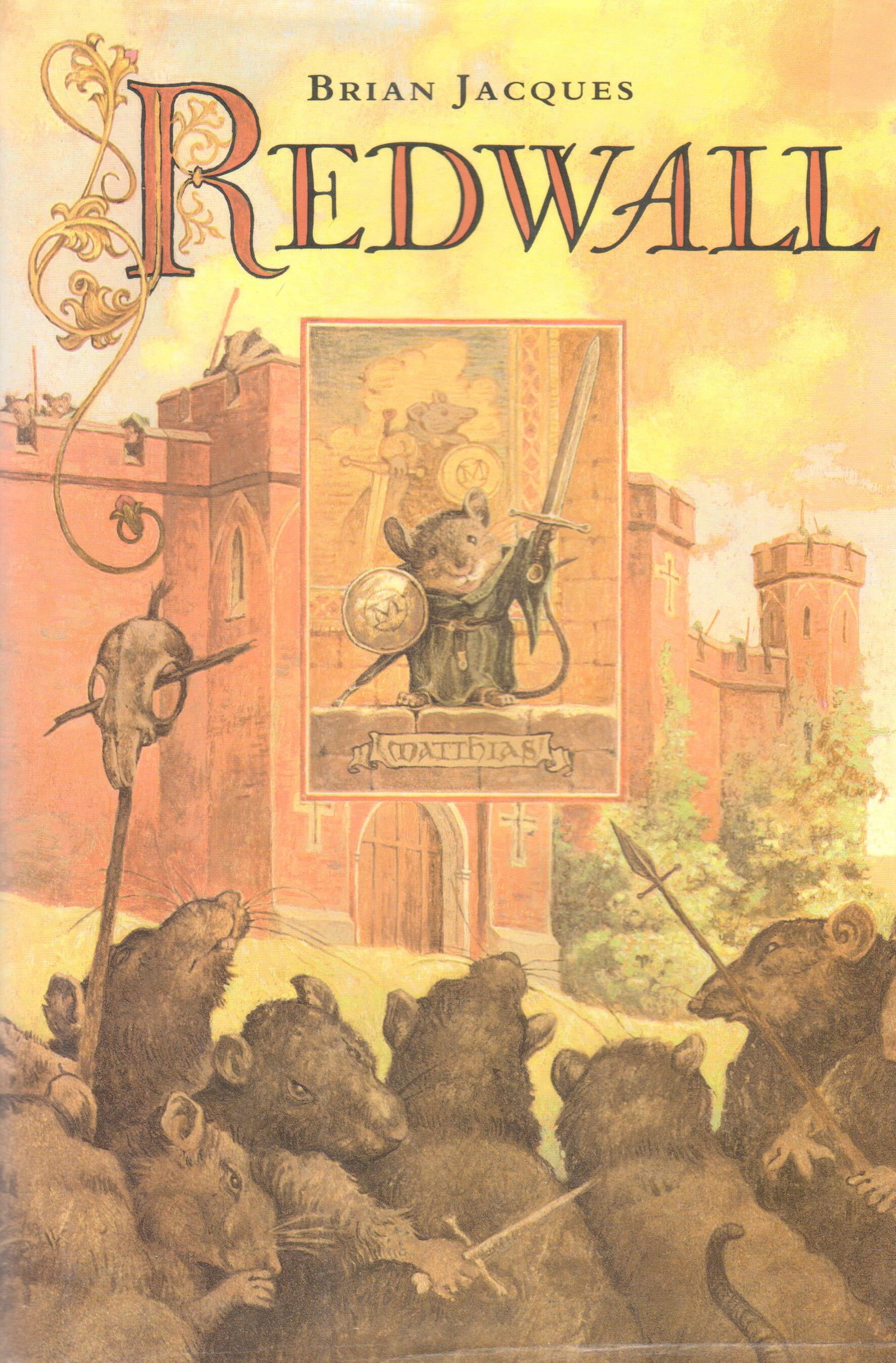
You should start reading with the first novel, simply titled: Redwall. You can see in this book the ideas that Jacques would develop in later volumes. I would suggest then reading Mossflower, which is a direct prequel to Redwall, telling how Martin the Warrior came to the Mossflower region. Martin is a real warrior mouse who wields an unbreakable sword made from meteoric iron that was forged by a badger Lord from Salamandastron, the smoking mountain of mystery. Even after death, Martin’s spirit continues on and guards the Abbey. In times of desperate trouble, his tapestry speaks to a select few, authorizing them to take up his sword and go on an adventure that will rescue the Abbey and its creatures. The third book, Mattimeo, is a direct sequel to Redwall. After that, you can read the books in whatever order you wish, according to whatever volumes are on the shelf when you visit your library! However, note that Mariel of Redwall and The Bellmaker go together, with The Bellmaker continuing the story of Mariel and her father, Joseph.
In publication order, which is mainly a good reading order, too, the books of the series are: Redwall, Mossflower, Mattimeo, Mariel of Redwall, Salamandastron, Martin the Warrior, The Bellmaker, Outcast of Redwall, The Pearls of Lutra, The Long Patrol, Marlfox, The Legend of Luke, Lord Brocktree, The Taggerung, Triss, Loamhedge, Rakkety Tam, High Rhulain, Eulalia!, Doomwyte, The Sable Quean, and The Rogue Crew.
A nice companion to this book series is the Redwall Map, which unfolds to a large, colorful map of the world of the books in the Redwall series. A perusal of this map, on the wall of the Plumfield Library, is a recommended activity after reading each book and especially after reading those books in the series that have their settings far from the Abbey.
Finally, in some sense the Redwall series is a mixture of The Wind in the Willows and the Freddy the Pig series, with just a dash of The Chronicles of Narnia mixed in. For me, comparing the Redwall books to these titles is very high praise indeed.
Brian Jacques (1939-2011) was born, raised, and resided in Liverpool, England, with some time spent overseas as a merchant seaman. He had many different jobs and always loved reading adventure stories and trying to write some himself. In the 1980s, he was a milk deliveryman, whose round included the Royal Wavertree School for the Blind. He volunteered to read to the blind children at the school. The 1980s were a low time for children’s literature, in my opinion, with many depressing “socially-conscious” titles. Jacques felt the same, so he started writing his own stories for the Royal Wavertree children. Since they were visually impaired children, the descriptions in his stories, more than is usual, included descriptions of sound, smell, taste, and touch. These stories resulted in the first Redwall book, published when he was 47 years old. Its success encouraged him to write twenty-one more titles in the series, with the last book, The Rogue Crew, published posthumously.